
Being a single parent and dreaming of homeownership might feel like an uphill battle, but it’s more achievable than you think. With the Australian Government 2% Deposit Scheme (formerly known as the Family Home Guarantee), competitive lenders, and strategic planning, thousands of single parents across Australia are successfully buying homes each year. This comprehensive guide walks you through everything you need to know about securing a home loan as a single parent, from understanding government schemes to boosting your borrowing power and finding the right lender who genuinely understands your situation.
Whether you’re working full-time, juggling part-time work, or receiving Centrelink payments, there are pathways to homeownership specifically designed with single parents in mind. Let’s break down the barriers and show you exactly how to make your family’s dream of a stable home a reality.
Understanding the Australian Government 2% Deposit Scheme for Single Parents
The game-changer for single parents looking to buy a home is the Australian Government 2% Deposit Scheme, specifically the Single Parent Stream (previously called the Family Home Guarantee). This isn’t just another government program with endless red tape. It is a practical solution that’s helping real families get into real homes.
What Makes This Scheme Different?
Unlike traditional home loans that typically require a 20% deposit, eligible single parents can purchase a home with just a 2% deposit. That’s right, on a $500,000 home, you’d only need $10,000 as a deposit, rather than the standard $100,000. The government steps in to guarantee up to 18% of your loan to participating lenders, which means you also avoid paying Lenders Mortgage Insurance (LMI), a cost that can easily run into tens of thousands of dollars.
Here’s what makes it even better: from October 1, 2025, the scheme now offers unlimited places with no income caps. Previously, there were annual quotas and income limits of $125,000 that restricted access. Those barriers are gone, making the pathway to homeownership significantly more accessible for single parents across all income levels.
Key Features of the Single Parent Scheme
The scheme is designed specifically for single parents and legal guardians with at least one dependent child. You don’t have to be a first-home buyer even if you’ve previously owned property, you can still be eligible as long as you don’t currently own a home when your new property settles.
Property Options You Can Choose From:
- Existing houses, townhouses, or apartments
- House and land packages
- Vacant land with a separate contract to build a home
- Off-the-plan apartments or townhouses
This flexibility means you’re not restricted to a narrow selection and you can find a home that genuinely suits your family’s needs and lifestyle.
Property Price Caps You Need to Know
While the scheme has become more accessible, there are still property price caps that vary by location. These caps were significantly increased in October 2025 to better reflect current market realities:
Major Capital Cities & Regional Centres:
- Sydney, NSW: $1.5 million
- Melbourne, VIC: $950,000
- Brisbane, QLD: $1 million
- Canberra, ACT: $1 million
- Perth, WA: $850,000
- Adelaide, SA: $900,000
- Hobart, TAS: $700,000
Other Regional Areas:
- NSW (other areas): $800,000
- Victoria (other areas): $650,000
- Queensland (other areas): $700,000
- Western Australia (other areas): $600,000
- South Australia (other areas): $500,000
- Tasmania (other areas): $550,000
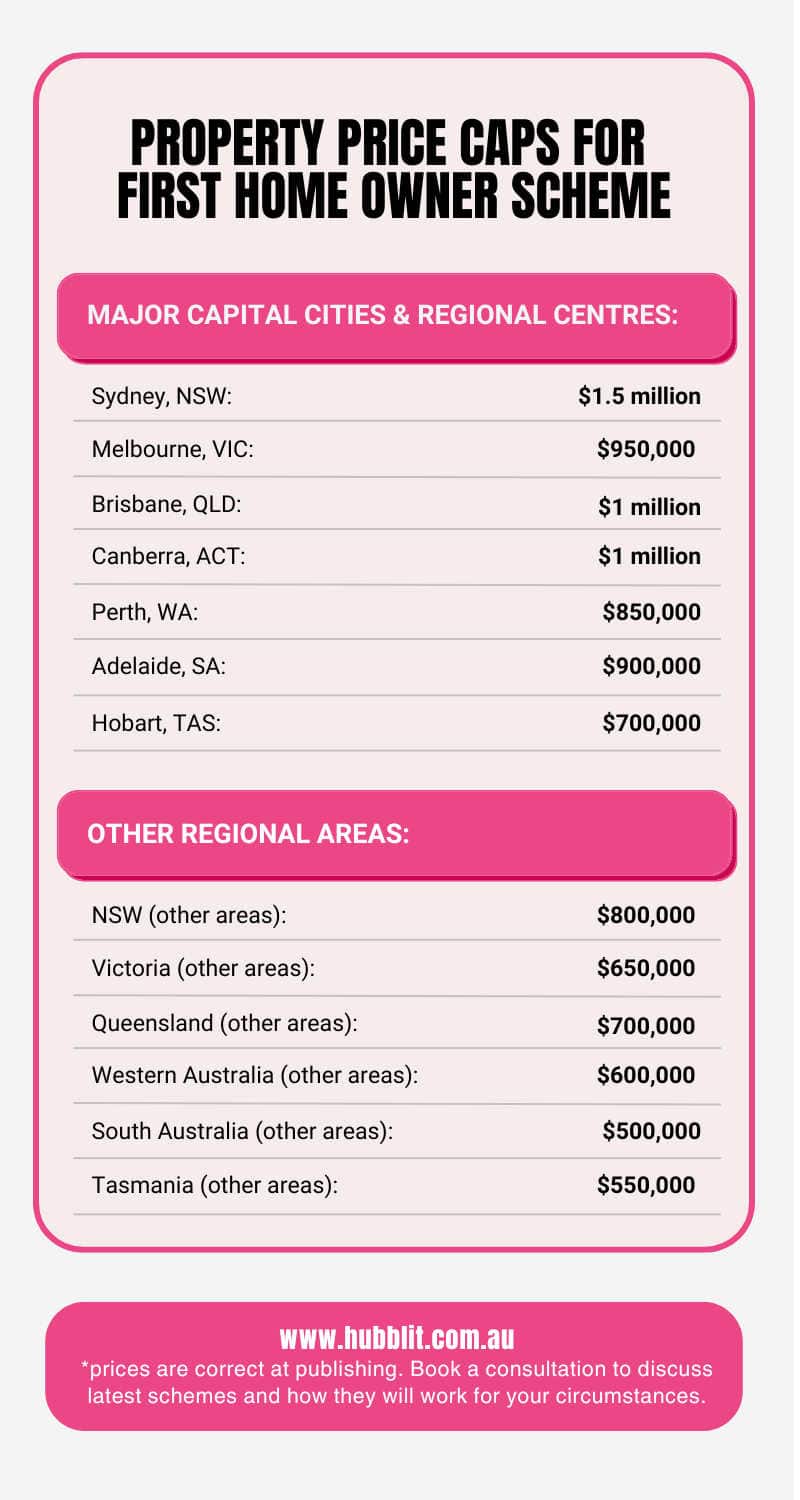
Both the purchase price and the property’s bank valuation must stay at or below these caps for your home to be eligible under the scheme.
Who Qualifies? Breaking Down Eligibility Requirements
Understanding whether you’re eligible is the first step toward making your homeownership dream a reality. The good news is that the requirements are straightforward, and many single parents meet them without realising it.
Personal Eligibility Criteria
To qualify for the Single Parent Stream of the Australian Government 2% Deposit Scheme, you must meet these core requirements:
1. Single Parent or Legal Guardian Status
You must be single, meaning you don’t have a spouse or de facto partner. If you’re separated but not yet divorced, you’re unfortunately not considered single under the scheme’s definition. You must be the natural parent, adoptive parent, or legal guardian of at least one dependent child.
2. Dependent Children Requirements
Your dependent children must be either:
- Under 16 years old and in your care, or
- Between 16-22 years old and earning below a certain annual income threshold
- Any age if they receive disability support pension and live with you
3. Citizenship and Residency
You must be an Australian citizen or permanent resident and at least 18 years old.
4. Property Ownership Status
You cannot have any other property interest once your new home settles. This is crucial and you need to divest any existing property ownership before settlement.
5. Owner-Occupier Requirement
The property must be your primary residence. You’re buying a family home, not an investment property.
Financial Requirements
Unlike previous versions of the scheme, there are no longer income caps as of October 1, 2025. This is a significant change. Previously, single parents earning over $125,000 annually were excluded from the program.
However, you still need to demonstrate that you can afford the loan repayments. Participating lenders will assess your:
- Regular income (employment, Centrelink, child support)
- Monthly expenses and living costs
- Existing debts and liabilities
- Credit history and score
- Genuine savings history
Deposit Requirements
The minimum deposit is 2% of the property’s value, plus you’ll need additional funds to cover purchasing costs such as:
- Stamp duty (though concessions may apply for first-home buyers)
- Legal and conveyancing fees
- Property inspections
- Lender fees
- Registration and title costs
It’s important to note that if your deposit exceeds 20% of the property value after paying all purchasing costs, the guarantee won’t apply because you wouldn’t need it.
Real Challenges Single Parents Face (And How to Overcome Them)
Let’s be honest, getting a home loan as a single parent comes with unique hurdles. Understanding these challenges is the first step to overcoming them.
Challenge #1: Lower Borrowing Power on a Single Income
As a single-income household, lenders assess your borrowing capacity more conservatively. If you earn $70,000 per year and have two children, lenders will factor in higher living expenses, which reduces how much they’re willing to lend you.
How to Overcome It:
- Include all acceptable income sources in your application (child support, Family Tax Benefits, part-time work)
- Work with lenders who recognise Centrelink payments as genuine income
- Consider a mortgage broker who specialises in single-parent applications. They know which lenders are more accommodating
Challenge #2: Saving a Deposit While Raising Kids
Between school fees, groceries, medical costs, and the endless stream of “Mum, I need…” requests, saving even a 2% deposit can feel impossible.
How to Overcome It:
- Take advantage of the First Home Super Saver Scheme (FHSSS), which lets you save up to $50,000 for your deposit inside your super account where it’s taxed at lower rates
- Automate small amounts into a dedicated savings account each payday, even $50 per fortnight adds up
- Apply for all eligible government benefits (Parenting Payment, Family Tax Benefit Parts A and B, Child Care Subsidy) to maximise your income
- Cut unnecessary subscriptions and use discount codes before every online purchase
- Build genuine savings over at least 3-6 months to show lenders you have financial discipline
Challenge #3: Credit Score Concerns
Many single parents have gone through financially challenging periods. Whether from divorce, job loss, or unexpected expenses, these may have impacted their credit score.
How to Overcome It:
- Check your credit report before applying (you can get a free report from Equifax, Experian, or Illion)
- Fix any errors or inaccuracies immediately
- Pay all bills on time for at least 6 months before applying
- Avoid applying for multiple loans or credit cards in the months leading up to your home loan application
- If you have past issues, some lenders are more understanding if you can demonstrate current financial stability
Challenge #4: Limited Deposit Means Higher Repayments
While a 2% deposit gets you in the door faster, it also means you’re borrowing 98% of the property’s value, which translates to higher monthly repayments.
The Reality Check:
If you’re borrowing $490,000 (98% of a $500,000 property), you would need an estimated gross annual income of approximately $93,000-$95,000 to comfortably service the loan while covering all your living expenses.
How to Overcome It:
- Use borrowing calculators to understand what you can realistically afford before falling in love with a property
- Don’t borrow at the absolute maximum of your capacity. Leave a buffer for unexpected expenses (because they will happen)
- Consider properties at the lower end of your price range to keep repayments manageable
What Income Do Lenders Actually Accept?
This is where many single parents get confused and it’s crucial to get it right. Different lenders have vastly different policies about which types of income they’ll consider when assessing your application.
Employment Income
Full-time employment is the gold standard for lenders, but part-time and casual work are absolutely acceptable. However, you may need to show at least 3-6 months of consistent employment, and some lenders may average your income if it’s variable.
Centrelink Payments
Family Tax Benefit (Parts A and B): Most lenders accept this as part of your income, though many require it to be supplementary to employment income. The age of your children may affect acceptance.
Parenting Payment: Generally accepted by several lenders as primary or supplementary income.
Disability Support Pension: Some lenders accept this with additional income requirements.
Carer Payment: Similar to disability payments, acceptance varies by lender.
JobSeeker: Almost never accepted by home loan lenders as a source of income.
The key point: Centrelink benefits alone typically aren’t enough to secure a home loan. Lenders want to see stable employment or multiple income streams to reduce their risk.
Child Support Payments
Here’s excellent news: many lenders accept child support as part of your income calculation, and importantly, child support is not counted toward the previous income cap under the Family Home Guarantee. You’ll typically need to provide either a court order or several months of bank statements showing consistent payments.
Self-Employment Income
If you’re self-employed or running a side hustle, lenders will generally want to see 1-2 years of tax returns or Business Activity Statements (BAS). The income needs to be consistent and verifiable.
Rental Income from Housemates
Some lenders will consider rent received from housemates or boarders if you can provide a lease agreement or consistent bank evidence showing regular deposits.
How Much Can You Actually Borrow?
Understanding your borrowing power is critical before you start house hunting. There’s nothing worse than falling in love with a property only to discover it’s beyond your reach.

Check out our calculators to see what will work for your financial situation.
Factors That Determine Your Borrowing Capacity
Lenders use a comprehensive assessment that includes:
Income Factors:
- Your gross annual income from all acceptable sources
- The stability and consistency of that income
- Whether income is likely to continue (e.g., child support ending when kids turn 18)
Expense Factors:
- Number of dependents (more children = higher living costs)
- Existing debts (credit cards, car loans, personal loans, HECS/HELP)
- Regular living expenses (childcare, school fees, groceries, utilities)
- Household Expenditure Measure (HEM) used by many lenders to estimate your basic living costs
Debt-to-Income (DTI) Ratio:
Most lenders prefer your total debt to be below 6 times your annual income. If you earn $80,000, they’d ideally like to see total borrowings (including the new home loan) below $480,000.
Improving Your Borrowing Power
Want to maximise how much you can borrow? Here’s what actually works:
- Pay down existing debts: Every dollar of existing debt you clear increases your borrowing capacity
- Close unused credit cards: Even if you never use that $10,000 limit card, lenders assume you could max it out tomorrow
- Include all income sources: Make sure your broker knows about child support, Family Tax Benefits, and any side income
- Apply with lenders who are single-parent friendly: Not all banks are equal, some are significantly more accommodating
Beyond the Family Home Guarantee: Other Support Available
The Single Parent Stream isn’t the only help available. Smart single parents stack multiple benefits to reduce their upfront costs significantly.
First Home Owner Grant (FHOG)
If you’re a first-home buyer and haven’t previously owned property, you may be eligible for a $10,000 grant in most states and territories. Requirements vary by state, but typically apply to new homes or substantial renovations.
State-Specific Details:
- NSW: $10,000 for new homes under $600,000 (or land + build under $750,000)
- Victoria: $10,000 for new homes under $750,000
- Queensland: $10,000 for new homes under $750,000
- South Australia, Western Australia, Tasmania, Northern Territory: $10,000 for new homes (varying value caps)
Stamp Duty Concessions and Exemptions
Stamp duty can add tens of thousands to your purchase cost, but first-home buyers can access substantial concessions or full exemptions.
NSW First Home Buyers:
- Full exemption on properties up to $800,000
- Concession on properties from $800,001 to $1,000,000
- Vacant land: exemption up to $350,000; concession up to $450,000
Victoria First Home Buyers:
- No stamp duty on properties up to $600,000
- Reduced duty on properties from $600,001 to $750,000
Queensland First Home Buyers:
- No transfer duty on properties under $700,000
- Concession on properties from $700,001 to $800,000
Other states and territories offer similar concessions. Check with your state’s revenue office or work with a mortgage broker who can identify all available savings.
State-Based Shared Equity Schemes
Some states offer additional support where the government co-purchases a portion of your home, reducing your loan size and monthly repayments.
Victoria: The Homebuyer Fund allows eligible buyers (including single parents) to purchase with a 2% deposit, with the government contributing up to 25% of the purchase price.
Western Australia: Similar shared equity schemes are available for eligible buyers.
These schemes can be combined with the Family Home Guarantee for even greater impact, though specific rules and eligibility vary by state.
Step-by-Step: Applying for Your Home Loan
Ready to take action? Here’s exactly how to navigate the application process successfully.
Step 1: Check Your Eligibility and Get Your Finances in Order
Before approaching any lender, take these preparatory steps:
- Review your credit report and address any issues
- Calculate your genuine borrowing capacity using online calculators
- Gather 3-6 months of consistent savings to demonstrate financial discipline
- Ensure all bills and existing debts are paid on time
- Collect documentation proving your single parent status and dependent children
Step 2: Choose Between a Lender or Mortgage Broker
You have two main pathways:
Applying Directly Through a Participating Lender:
All major banks participate in the scheme, including Commonwealth Bank, NAB, Bendigo Bank, and many others. You can find the full list on Housing Australia’s website.
Working With a Mortgage Broker:
Many single parents find this the better option because brokers:
- Know which lenders are most accommodating to single parents
- Have access to exclusive deals not publicly advertised
- Handle all paperwork and liaise with lenders on your behalf
- Can match your specific income situation (including Centrelink payments) with the right lender
- Save you time and reduce stress
Importantly, mortgage broker services are free to you. They’re paid commission by the lenders (read more about What a mortgage broker does )

Don’t have a mortgage broker? Reach out to our team for free advice.
Step 3: Prepare Your Documentation
Having all your documents ready speeds up the process dramatically. You’ll need:
Personal Identification:
- Photo ID (driver’s license or passport)
- Medicare card or PMKey
- Proof of Australian citizenship or permanent residency
Income Verification:
- Recent payslips (typically last 3 months)
- Last two years’ tax returns (if self-employed)
- Centrelink payment statements
- Court order or bank statements showing child support payments
Financial Documents:
- Bank statements (typically 3-6 months)
- Proof of genuine savings
- Statements for all debts (credit cards, personal loans, HECS/HELP)
Single Parent Evidence:
- Documents proving you’re a single parent or legal guardian with dependent children
- Birth certificates or custody documents
Property Documents (once you’ve found a home):
- Contract of sale
- Building and pest inspection reports
Step 4: Get Pre-Approval
Pre-approval (also called conditional approval) is a lender’s agreement in principle to lend you a certain amount, subject to property valuation and final checks. This typically lasts 90 days and gives you confidence when making offers.
Step 5: Find Your Home and Reserve Your Guarantee Place
Once you have pre-approval, you have 90 days to find and purchase your property. When you make an offer on a home that meets the scheme criteria, your lender will reserve a guarantee place for you with Housing Australia.
The good news: with unlimited places now available under the scheme, you don’t need to worry about missing out due to quota limits.
Step 6: Final Approval and Settlement
After your offer is accepted, the lender conducts a formal property valuation to ensure it meets their standards and doesn’t exceed the price cap. If everything checks out, you’ll receive final approval and proceed to settlement.

Smart Strategies: Making Homeownership Work Long-Term
Getting the loan is just the beginning. Making it work for your family long-term requires strategy and planning.
Create a Realistic Budget and Stick to It
Track your income and expenses for at least one month to understand exactly where your money goes. Categorise spending into ‘needs’ (mortgage, groceries, utilities) and ‘wants’ (entertainment, subscriptions).
Many single parents find the 50/30/20 rule helpful: 50% of income on needs, 30% on wants, and 20% on savings and debt repayment. Adjust these percentages to fit your situation, especially while establishing yourself as a homeowner.
Build an Emergency Buffer
Life with kids is unpredictable. School excursions, dental emergencies, car repairs. Unexpected expenses will happen. Aim to build a small emergency fund of at least $1,000-$2,000 once you’re settled, then gradually increase it to cover 3 months of essential expenses.
Consider Fortnightly Repayments
Instead of paying your mortgage monthly, switch to fortnightly payments. This simple change means you make 26 half-payments per year (equivalent to 13 full monthly payments instead of 12), which can shave years off your loan and save thousands in interest.
Maximise Government Benefits You’re Entitled To
Ensure you’re claiming all available support:
- Parenting Payment (if eligible based on income and youngest child’s age)
- Family Tax Benefit Part A and Part B
- Child Care Subsidy (if using childcare)
- Rent Assistance (if applicable before purchase)
Every dollar of legitimate support helps ease the financial pressure and improves your borrowing capacity for the future.
Plan for Rate Rises
Interest rates can and do change. When calculating what you can afford, stress-test your budget by adding 2-3% to the interest rate. If you can still manage the repayments at that higher rate, you’ve got a safety buffer.
Which Lenders Are Actually Single-Parent Friendly?
Not all lenders treat single parents equally. Based on real experiences and broker recommendations, these lenders have track records of being more accommodating:
Major Banks:
- NAB (National Australia Bank): Known for favorable treatment of Centrelink payments, particularly Family Tax Benefits
- Commonwealth Bank: Participates in the scheme and has dedicated first-home buyer and single-parent support
- Bendigo Bank: Frequently mentioned by single parents as accommodating and easier to work with
Regional and Mutual Banks:
- Beyond Bank: Good track record with single parents; considers child support positively
- Bank Australia: Offers the Australian Government 2% Deposit Scheme with supportive processes
- IMB Bank: Participating lender with clear guidance for single parents
- People’s Choice Credit Union: Actively promotes support for single parents
Specialist Lenders:
Several non-bank lenders specialise in more complex income situations, including single parents with Centrelink income. A mortgage broker can connect you with these options.
The key takeaway: don’t just apply with your current bank. Shop around or use a broker who can compare multiple lenders to find the best fit for your specific circumstances.
Common Mistakes to Avoid
Learn from others’ experiences and sidestep these common pitfalls:
Mistake #1: Not Checking Your Credit Report First
Discovering defaults or errors on your credit report after applying can torpedo your application. Check it before you start. It’s free and takes minutes.
Mistake #2: Applying to Multiple Lenders Simultaneously
Each application creates a “hard inquiry” on your credit report. Too many in a short period signals financial stress and can reduce your credit score. Work with one lender at a time, or better yet, use a broker who can submit to appropriate lenders strategically.
Mistake #3: Changing Jobs During the Application Process
Job stability is crucial. If possible, avoid changing employment while applying for a loan. If you must change, ensure you’re past any probation period before applying.
Mistake #4: Underestimating Expenses
Be honest about your actual living costs. Lenders will scrutinise your bank statements, and “accidentally” underestimating expenses looks like dishonesty. Plus, you need to know you can truly afford the repayments.
Mistake #5: Maxing Out Your Borrowing Capacity
Just because you’re approved for $600,000 doesn’t mean you should borrow that much. Interest rates change, kids get more expensive as they age, and life happens. Borrow conservatively.
Mistake #6: Not Having Proper Property Inspections
Buying a home with hidden structural issues or pest problems can lead to rejection by the lender or, worse, expensive problems after you’ve bought. Always get professional building and pest inspections.
Mistake #7: Letting Your Pre-Approval Expire
Pre-approvals typically last 90 days. If you can’t find a suitable property in that time, you’ll need to start the process again. Be realistic about the market and start looking as soon as you have pre-approval.
Real Talk: Is This Actually Achievable?
Let’s address the elephant in the room. You might be reading this thinking, “This all sounds good, but can I really do this?”
The answer is yes, but it requires realistic expectations and proper planning.
The Reality:
- Over 15% of home buyers in Australia are single-parent households
- Thousands of single parents successfully use the Family Home Guarantee each year
- With unlimited places now available, there’s no longer a race to “grab a spot”
The Challenges:
- Monthly repayments on a low-deposit loan are substantial (budget carefully)
- You’ll need stable income that lenders accept (employment is crucial)
- The process takes time. Don’t expect to be in your new home next month
The Rewards:
- Stability: No more worrying about landlords selling or rent increases
- Security: Building equity and wealth for your children’s future
- Pride: Achieving something significant entirely on your own terms
- Savings: Mortgage repayments can be comparable to or less than rent in many markets
The single parents who succeed are those who:
- Do their research thoroughly (you’re doing that right now)
- Get their finances organised before applying
- Work with professionals who understand their situation
- Choose properties they can genuinely afford, not just ones they qualify for
- Plan for the unexpected and build financial buffers
Your Next Steps: Taking Action Today
You’ve now got comprehensive knowledge about home loans for single parents in Australia. Knowledge is power, but only if you act on it. Here’s your action plan:
This Week:
- Check your credit report (free through Equifax, Experian, or Illion)
- List all your income sources and calculate your approximate borrowing capacity
- Review your current spending and identify areas where you can save more
This Month:
- Set up a dedicated savings account and automate regular deposits
- Research participating lenders or contact 2-3 mortgage brokers who specialise in single-parent applications – Book a consult with our brokers
- Apply for any government benefits you’re entitled to but not currently receiving
- Start researching properties in your price range to understand the market
Next 3-6 Months:
- Build your genuine savings history with consistent deposits
- Pay all bills on time to strengthen your credit score
- Gather all required documentation
- Get pre-approval from a lender
- Start actively house hunting within your realistic price range
Before You Settle:
- Get professional building and pest inspections
- Have a solicitor or conveyancer review the contract
- Ensure you have funds for settlement costs and a small emergency buffer
Frequently Asked Questions
Can I get a home loan if I’m receiving JobSeeker payments?
Unfortunately, almost no lenders accept JobSeeker as income for home loan purposes. You would need additional income from employment or other stable sources to qualify.
Do child support payments count toward the $125,000 income limit?
Great news, child support payments do not count as taxable income, so they weren’t included in the previous income cap calculation. Moreover, as of October 2025, income caps have been completely removed from the scheme.
How long does the approval process take?
Pre-approval can take 2-4 weeks depending on your documentation and the lender’s workload. Final approval after finding a property typically takes another 2-4 weeks.
Can I use the Family Home Guarantee if I’ve owned property before?
Yes, absolutely. Unlike the First Home Guarantee which is strictly for first-time buyers, the Single Parent Stream is available to anyone who meets the eligibility criteria, regardless of whether they’ve previously owned property. As long as they don’t currently own any property when the new home settles.
What if I’m separated but not yet divorced?
Unfortunately, if you’re legally separated but not yet divorced, you’re not considered “single” under the scheme’s definition and won’t be eligible. You’ll need to finalise your divorce before applying.
Can I buy an investment property under this scheme?
No. The scheme is specifically for owner-occupied properties that you intend to live in as your primary residence.
What happens if I lose my job after getting the loan?
This is a serious concern, which is why lenders stress-test your application and why it’s crucial to have an emergency fund. If you lose your job, immediately contact your lender to discuss hardship options. Most have processes to help you through temporary difficulties. This is also why you should never borrow at the absolute maximum of your capacity.
Final Thoughts: You’ve Got This
Buying a home as a single parent in Australia is challenging, but it’s far from impossible. The Australian Government 2% Deposit Scheme has opened doors that were previously locked for thousands of families just like yours.
Yes, you’ll need to be organised, patient, and strategic. Yes, there will be paperwork and hoops to jump through. But on the other side of that process is a home (your home) where your children can grow up with stability, where you’re building equity instead of paying someone else’s mortgage, and where you’ve achieved something genuinely remarkable.
The system isn’t perfect, and the journey won’t always be smooth. But with the right support, realistic planning, and determination, homeownership as a single parent is absolutely within your reach. Thousands have done it before you, and thousands more will do it after you. Why not be one of them?
Start with that first step today. Check your credit report, open that savings account, or call a mortgage broker. Small actions compound into life-changing results. Your family’s future home is waiting.

Are you in the market for a new home but pulling your hair out trying to work out the loan side of things?
Book a call with our expert brokers today.
Disclaimer: This guide provides general information only and should not be considered personal financial advice. Home loan eligibility, government schemes, and property market conditions can change. Always consult with licensed financial professionals, mortgage brokers, and legal advisors about your specific circumstances before making property purchase decisions. Verify current program details directly with Housing Australia and participating lenders, as terms and conditions may have changed since publication.